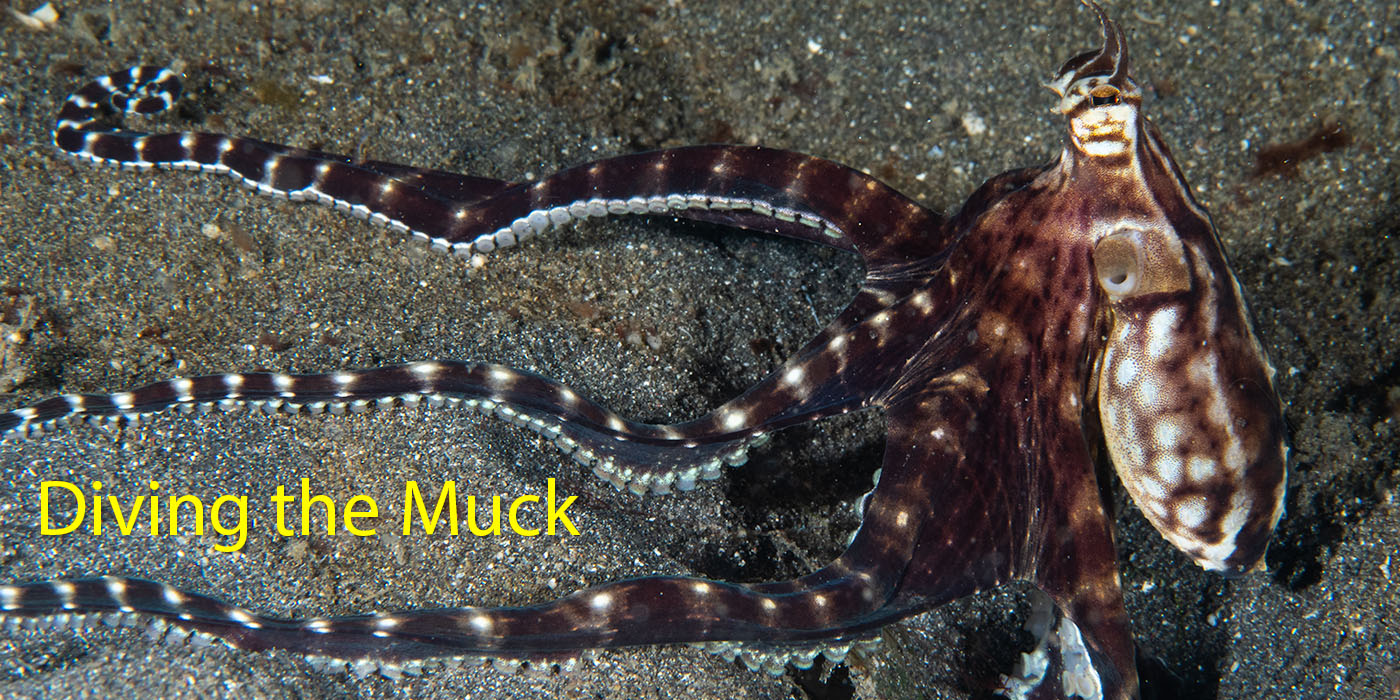
During Covid we kept up with some of our contacts in Asia including Bruce and Fung who run the Black Sand Dive Retreat in the Lembeh Strait in Sulawesi. Having come all this way for our 2023 diving trip we had to stop off there for a few days on our way home. Although we have had fabulous diving for 12 days, the Lembeh Strait is unique and world-famous for the opportunity to see unusual marine life. Manado is a one hour fifteen minute flight from Sarong in West Papua where we left our boat and then another hour and a half across Sulawesi on a new, and deserted, Chinese built motorway to Bitung and then over the hills to the resort.

Lembeh Strait from our Villa, Vicky on the way to the Dive Centre

Coconut Octopus, Flounder
 I have dived twice with BSDR in Lembeh before while we were living in Singapore. We first discovered it in 2015 and I went back in 2016 when Vicky was away in London. The strait between Sulawesi and Lembeh Island is a few kilometers long with a black sandy bottom and nutrient rich waters coming from the deep nearby. The dive sites are all along both sides of the strait and also around small islands in the middle as you can see on the map from the dive centre (right).
On most dives you drop onto a black sandy bottom at about 6-9 metres and then swim down a gentle slope to between 20-25m. There is some coral in some sites but in others just a sandy seabed desert. However scuttling around or hiding in the sand are rare scorpionfish, octopus, frogfish and nudibranchs in all sizes. The coconut octopus (above) is quite common. The smaller ones are a tasty morsel for flounders which lurk in the sand, well disguised, and will pounce on an octopus if they can find one.

Two Broadclub Cuttlefish - baby (l) and midsize (r)

Juvenile Mimic Octopus, White-V Octopus
Our dive guide, Etmo, is very good at finding cephalopods. Often just the top of their eyes are protruding from the sand but a gentle prod under the sand with a pointer will coax them out. We find cuttlefish in all sizes from 3cm (above left) to medium and large. In addition to the coconut octopus we see a big reef octopus and also two, rarer, mimic octopuses (above and header) and also the rare white-V or long-arm octopus. Etmo takes some shells out of his jacket and tries to persuade one coconut octopus to climb into it but he is not playing ball. Perhaps the most exciting find are some flamboyant cuttlefish eggs in a coconut shell - you can see the babies moving in their eggs, and a tiny, newly hatched flamboyant cuttlefish only a few millimeters long. Hence my rather unsharp image!
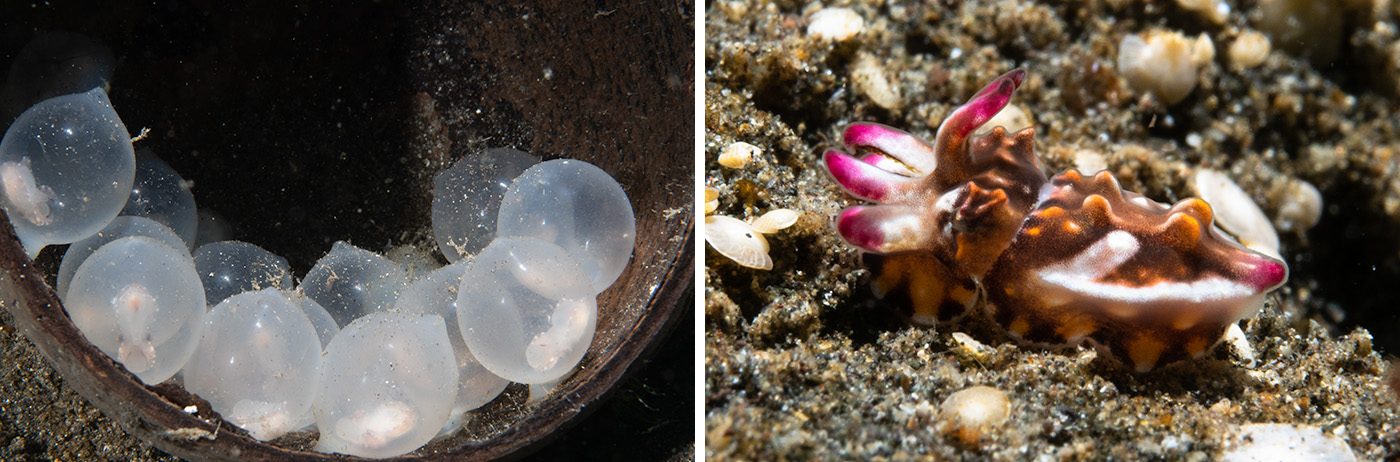
Cuttlefish eggs, newly hatched flamboyant cuttlefish

Lembeh frogfish (L&R), Flasher scorpionfish centre
Diving in the Maldives last year there was huge exciting when we found a very small frogfish. These extraordinary creatures are rare to find diving in the Tropics but a regular feature of Lembeh dives. They come in all shapes, sizes and colours - yellow, orange, black and white. Some have so many spikes and holes that it is hard to pick out their features. Sadly we don't see the amazing hairy frogfish this time. Most endearing are their lateral fins which look like little paws and which they use to move around on reef walls or the seabed. I have just learned that what I thought was frogfish - middle above - is in fact a Flasher Scorpionfish (or perhaps the Devil Scorpionfish per my fishbook).

Robust Ghost Pipefish, Ornate Ghost Pipefish

Tiny Pigmy Pipefish, Seahorse, Ornate Ghost Pipefish
The pipefish family are also exciting to find. Pigmy seahorses are most sought after but I also love the ornate ghost pipefish. We find one hovering by a crinoid which is beautifully disguised - I wait for ages for it to drift away so that I can photograph it. The robust ghost pipefish, green or reddy-brown, wafts around in the water looking like a leaf drifting on the bottom. Seahorses can be rather disappointing to view as they often lie in the sand or float prone, just above the seabed. I was very happy with my shot of the pigmy pipefish (above left) as it looked like a little green thread, about 4cm long.

Tiny Thecacera nudibranch (Picachoo), Hysolodoris
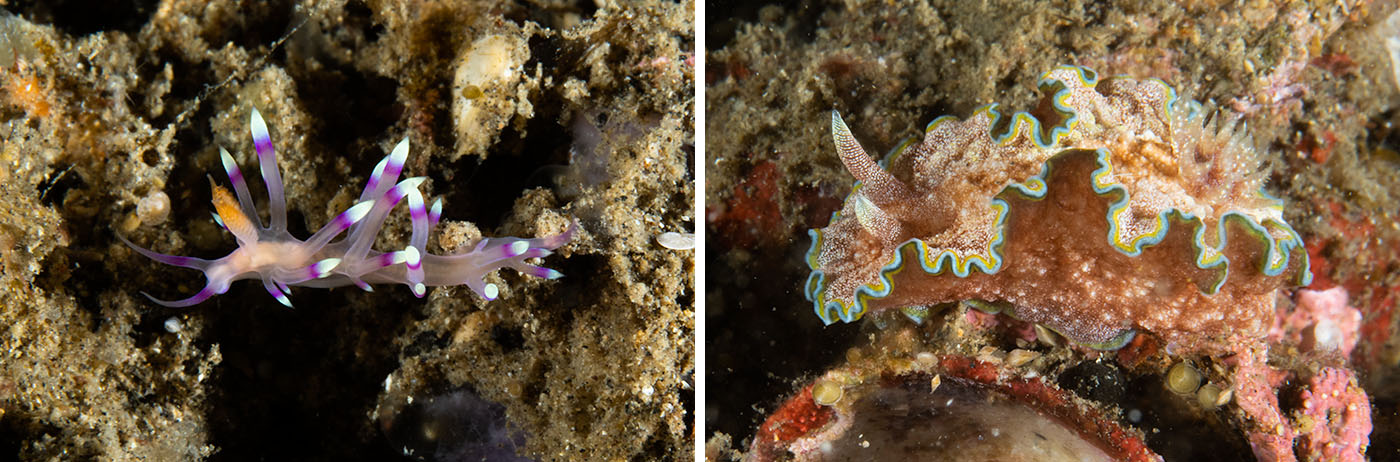
Flabellina Rubrolineata, Glossodoris
Photographers love nudibranchs, partly for their variety and colour but also because they move very slowly and are easier to capture. Mind you some are only a few millimetres long which makes focusing a challenge! Etmo pointed out something on a small golden tumbrel which I snapped and could only see little 'picachoo' when I loaded it onto the computer. The bigger nudibranchs are easier to spot but again, at depth, they might look drab. The Hysolodoris (above right) looked grey-green until I shot it with the flash and all these great colours came out. A good reason to carry a torch on a dive.

Minute Filefish, Puffer Filefish (juv)

Zanzibar whip coral shrimp, Decorator Crab
More gorgeous small stuff. The two filefish above are both about 1cm across. They tend to hover around a small area so are not too hard to photograph although I had to wait for ages for the one on the left to come out from behind a small sponge. The shrimp was another of Etmo's tiny discoveries - just a few millimetres I had to wait to see it on the screen. Decorator crabs come in many forms - some are long-legged and spindly while others are covered in big spongy blobs. I loved the one above which appeared to have polyps growing all over him.

Spiny Waspfish, Cockatoo Waspfish
Vicky says that she is not a great fan of muck diving. There is none of the excitement of hanging on a reef wall or drifting past gorgeous masses of soft coral. It is more like a day on safari or out birdwatching when you have a lot of time with little to see and then you come across rare gems. You will see from this post that there are quite a lot of rare gems that you can see in three days - a lot due to the sharp eyes and experience of Etmo, but also because of this extraordinary place, the Lembeh Strait.

Ambon Scorpionfish